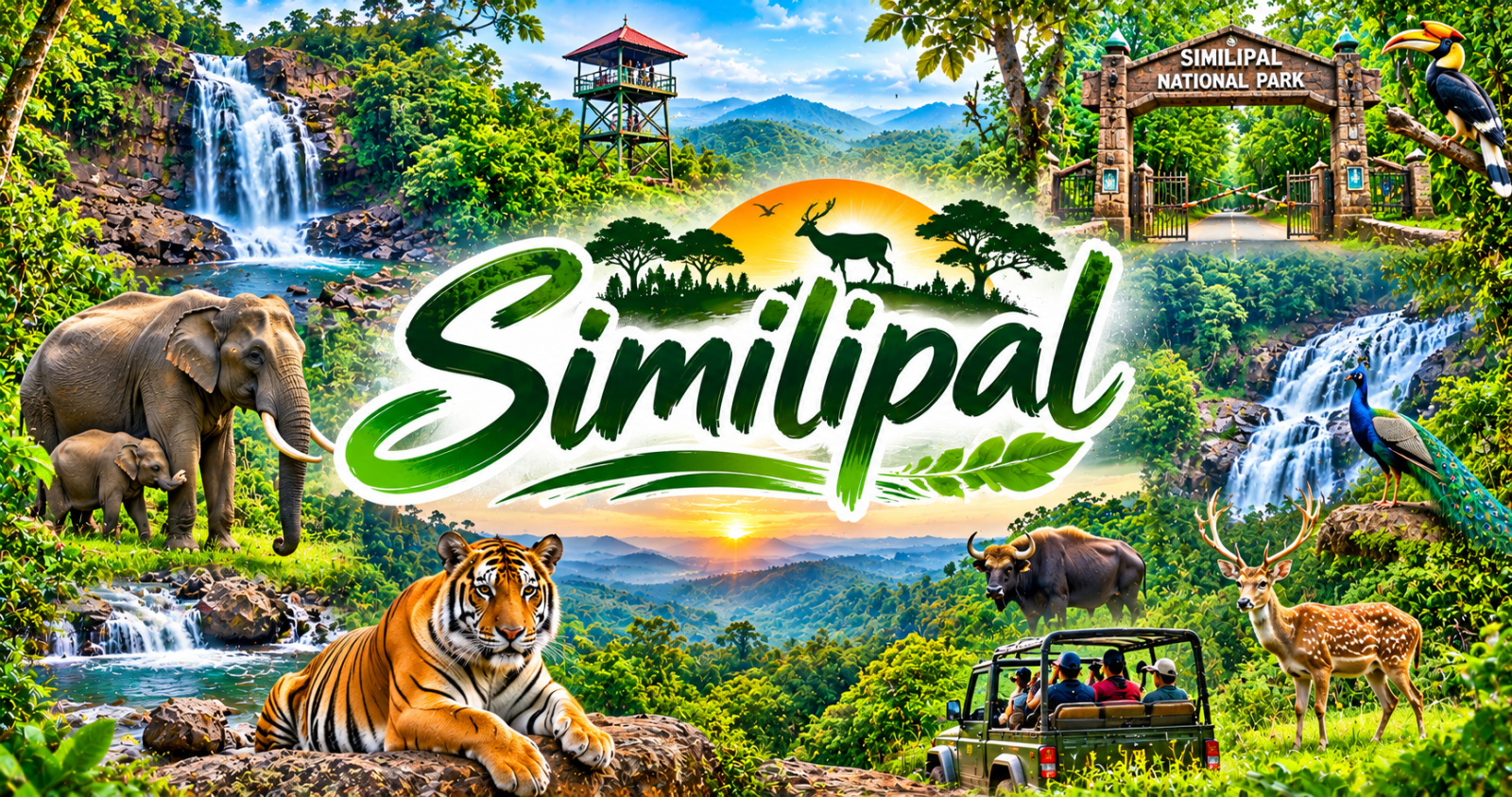
Odisha Tour
✎ OM Leisure Holidays
📅 03 Nov 2026
Similipal Tiger Reserve: Where Wild Odisha Still Keeps Its Secrets
The first thing you notice in Similipal isn’t a tiger. It’s the quiet.
Around 6 a.m. your jeep rolls past the Lulung gate and the engine noise seems to fade into the forest. Mist hangs low between the sal trees. A peacock calls from somewhere you can’t see. Then your guide slows down and points at a fresh set of pugmarks pressed into the red earth, still sharp at the edges. Nobody says a word.
That’s the Similipal we love sharing with our travellers at Om Leisure Holidays. It doesn’t put on a show. It slowly lets you in, one sound and one footprint at a time. If you’re a photographer, a birder, a family looking for a different kind of holiday or someone who just needs a break from city noise, this guide covers what makes Similipal special, and how we can help you experience it properly.
🐅 Planning a Similipal trip? Om Leisure Holidays takes care of permits, forest stays, safaris and transfers so you can just enjoy the forest. Explore our Similipal packages →
Where Is Similipal?
Similipal Tiger Reserve sits in the Mayurbhanj district of northern Odisha, about 250 km from Bhubaneswar and roughly 60 km from Baripada. Its name is usually traced to the simul, the red silk-cotton tree that flowers across the forest every spring.
Covering about 2,750 sq km, it’s one of the largest protected forests in India. Similipal isn’t flat jungle. It rises into a high plateau ringed by hills, with peaks like Khairiburu (about 1,168 m) and Meghasani (about 1,158 m) looking down over valleys, grasslands and river gorges. More than a dozen rivers start here, including the Budhabalanga, Khairi and Salandi, which is why locals call Similipal the lifeline of Mayurbhanj.
A Short History of a Long-Protected Forest
Before it became a reserve, Similipal was the royal hunting ground of the Maharajas of Mayurbhanj. That royal claim is part of why so much of the forest survived into the modern era.
1956: Formal protection of the Similipal forests begins
1973: One of India’s first nine tiger reserves under Project Tiger
1979: Declared a wildlife sanctuary by the Government of Odisha
1994: Declared a biosphere reserve by the Government of India
2009: Added to UNESCO’s World Network of Biosphere Reserves
Today Similipal is still wild, thanks to forest staff, researchers and the local communities who protect it. That’s why we at Om Leisure Holidays focus on responsible, low-impact travel in the reserve.
Climate: When Should You Go?
Winter (November–February): Cool and pleasant, around 10–15°C, and colder on the plateau at night. This is the most comfortable time and our most popular season for Similipal trips.
Summer (March–June): Hot, sometimes reaching 40–45°C in lower areas. Animals gather near water, so sightings are often better.
Monsoon (July–October): Heavy rain and a lush green forest. The reserve is generally closed to tourists during this period.
📅 Not sure which month suits you? Our travel experts can suggest the best dates for your interests, whether that’s wildlife, photography, waterfalls or a relaxed family trip. Talk to us →
The Wildlife: Flora and Fauna
The Big Names
The Bengal tiger is the star, and Similipal has a claim no other forest on Earth can make: it’s the only known wild home of melanistic, or “black,” tigers. A genetic variant makes their stripes so thick and merged that the cats look almost dark. Sightings are extremely rare, but knowing they walk these trails makes every safari feel a little electric.
You may also spot:
Asian elephants, often near water sources
Gaur (Indian bison), huge and surprisingly calm
Chausingha, the world’s only four-horned antelope
Leopards, sloth bears, sambar, spotted deer, barking deer and flying squirrels
Mugger crocodiles at the Ramtirtha crocodile centre near Jashipur
By the Numbers
Category Approximate species
Orchids 93
Medicinal plants 300+
Rare and endangered plants 52
Mammals 42
Birds 242
Reptiles 30
Figures vary between surveys and new species keep being recorded.
For Birders and Photographers
Hornbills, crested serpent eagles, red junglefowl, hill mynas and racket-tailed drongos are regulars. In spring the forest turns red and orange with simul and palash blooms. Om Leisure Holidays can arrange early-morning safaris and experienced local naturalists to help you get the best sightings and the best light.
The Waterfalls of Similipal
Many travellers come for the tigers but leave talking about the waterfalls.
Barehipani Waterfall
The highest waterfall in Odisha and among the tallest in India, Barehipani plunges about 399 metres (roughly 1,309 ft) in two tiers off the plateau. The roar echoes through the gorge where the Budhabalanga river begins its journey to the plains. A visit to Similipal without seeing Barehipani feels unfinished, which is why it’s included in every Om Leisure Holidays Similipal itinerary.
Joranda Waterfall
Joranda is a clean, single, near-vertical drop of about 181 metres (594 ft) into a deep gorge. It’s simple, dramatic and one of the most photographed spots in Odisha. Many visitors find the place calming, a reminder of how good it feels to stand still somewhere loud with water rather than traffic.
Uski Waterfall
Where the Bhandan river tumbles over rocks, it forms Uski, a smaller and more intimate cascade you can get close to. It’s a quiet, refreshing stop away from the bigger crowds.
Devkund, Sitakund, Chahala and More
Devkund: a natural pool fed by a waterfall, with a small temple of Goddess Ambika nearby
Sitakund: a peaceful pool tied to local legend
Chahala: an old royal hunting lodge area in grassland, great for spotting elephants and gaur at dusk
Meghasani: the “seat of the clouds,” with sweeping views over the forest
🌊 Want to see all the major waterfalls in one trip? Our Similipal itineraries are planned around the best routes, so you spend more time exploring and less time travelling. View itineraries →
The People and Culture of Similipal
Similipal is also a cultural landscape. Communities such as the Santhal, Ho, Kolha, Bhumija, Munda and Kharia, along with the forest-dwelling Mankirdia and Hill Kharia, have lived in and around these hills for generations. Honey, sal leaves, siali fibre and medicinal plants from the forest have supported families for centuries, and festivals like Sohrai and Baha keep that bond alive.
On our trips we encourage travellers to meet local eco-tourism guides, try local food and buy village honey and handicrafts. It’s a simple way to make sure your holiday supports the people who protect the forest.
Why Book Your Similipal Trip with Om Leisure Holidays?
Planning Similipal on your own can be tricky. Permits are limited, forest stays fill up fast, entry rules change from season to season and some roads inside the reserve need experienced drivers. That’s where we come in.
When you book with Om Leisure Holidays, you get:
✅ Permits and entry arranged so there’s no last-minute stress at the gate
✅ Handpicked stays, from forest nature camps to comfortable hotels in Baripada and Jashipur
✅ Safari vehicles and experienced local guides who know the forest well
✅ Pickup and drop-off from Bhubaneswar, Kolkata, Balasore or Baripada
✅ Flexible itineraries for families, couples, photographers, groups and solo travellers
✅ Support throughout your trip, from your first enquiry to the day you get home
📞 Ready to explore Similipal?
Call / WhatsApp: +919338757567
Email: info@omleisureholidays.com
Book your Similipal tour now →
Quick Travel Tips
Best time to visit: November to June. The reserve usually closes from mid-June to October 31, and our team will confirm the current dates when you enquire.
How to get there:
By air: Bhubaneswar (about 250 km) or Kolkata (about 280 km)
By rail: Baripada (nearest) or Balasore
By road: through the Lulung gate (near Baripada) or the Kalikaprasad gate (near Jashipur)
Om Leisure Holidays can arrange all transfers for you.
What to pack: Earth-toned clothes, comfortable shoes, a light jacket for winter mornings, insect repellent, a reusable water bottle, binoculars and a camera with a good zoom lens.
Travel Responsibly
Similipal is beautiful but fragile. As travellers, and as a travel company, we believe in leaving the forest as wild as we found it:
Don’t litter, and carry your waste back out
Keep noise low, with no loud music or horns
Stay in vehicles and on marked trails
Never feed or approach wild animals
Follow your guide’s and the forest staff’s instructions
Support local communities
Final Thoughts
Similipal isn’t just a park. It’s a living forest where tigers still roam, rivers are born and ancient cultures continue. Watch the mist rise off Barehipani, wait quietly by a waterhole at dusk and listen to a local guide tell the story of the hills. These are moments you’ll carry home for years.
Let Om Leisure Holidays handle the planning while you take in the wild.
🐾 Your Similipal adventure starts here.
Enquire now → | 📞 +91 9338757567
Website: omleisureholidays.com
Have questions about visiting Similipal? Drop them in the comments or contact our team. We’re happy to help you plan.
Share this article: